Connect WhatsApp and SMS in one secure, automated communication flow. With SMSEagle, your WhatsApp messages can be forwarded, converted, or mirrored to SMS – ensuring your message reaches every recipient. WhatsApp to text feature allows you to easily bridge the gap between these two messaging formats. Keep your communication reliable, and fully under your control.
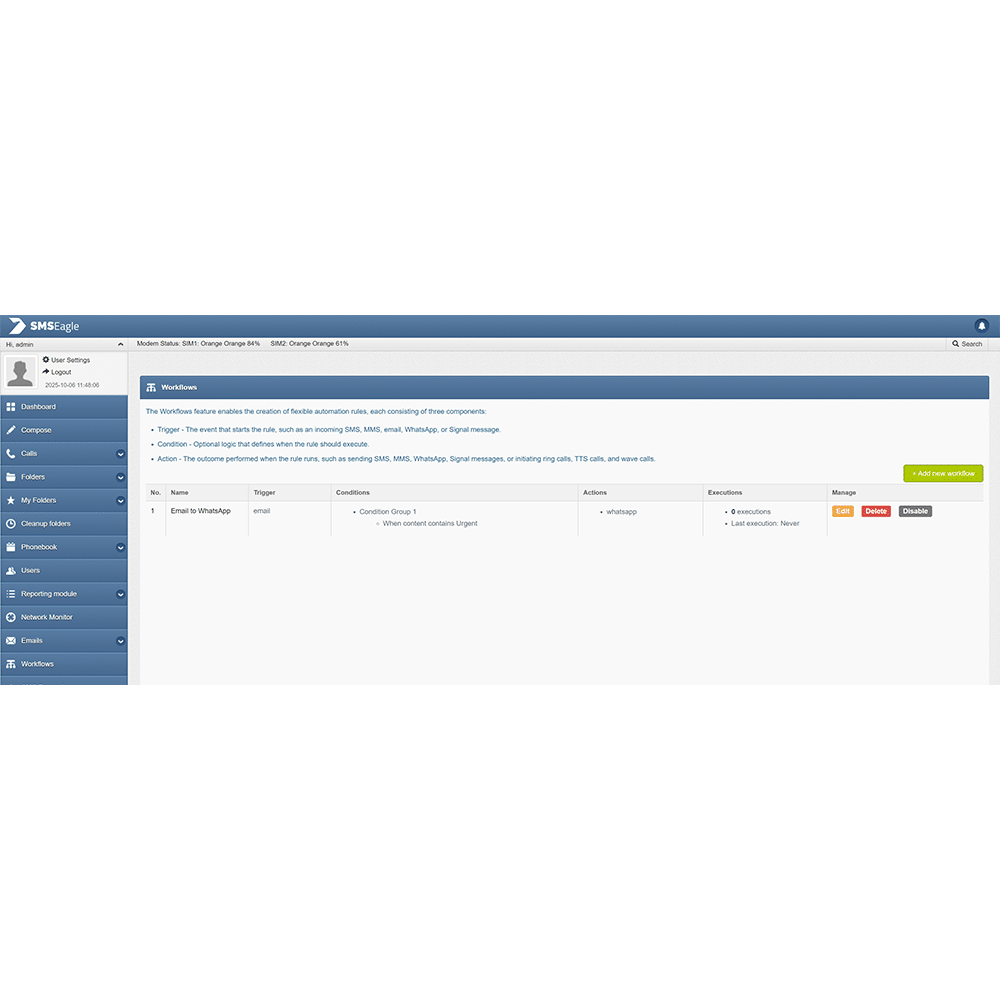
Open your web browser and log in to your SMSEagle web interface using your admin credentials.
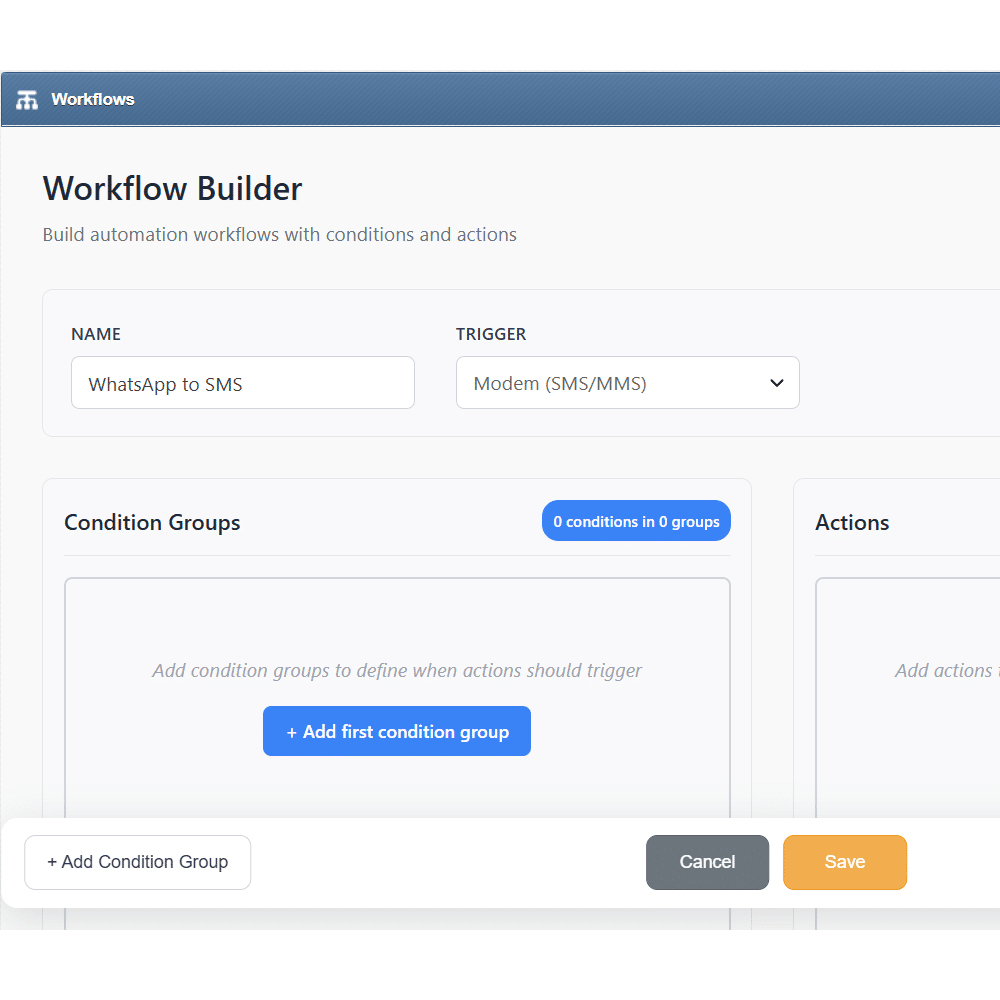
In the top-right corner of the Workflows page, click + Add new workflow.
In the Name field, enter a descriptive title such as “WhatsApp to SMS” or “WhatsApp to text”.
In the Trigger dropdown menu, select WhatsApp.
This means the workflow will activate each time a WhatsApp message is received.
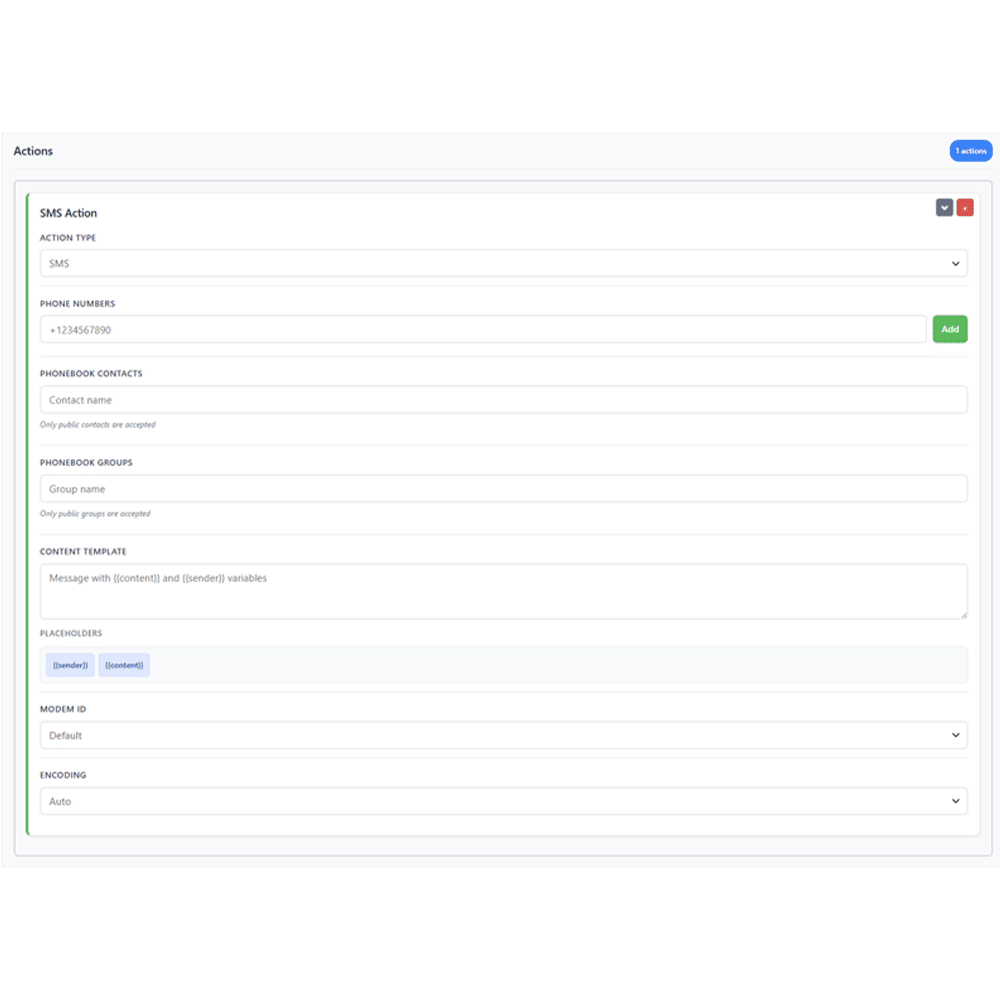
Message with {{content}} and {{sender}} variables
Using templates not only streamlines outbound communications but also helps ensure compliance with messaging policies, as templates can be pre-approved and standardized for consistent use. This ensures the forwarded SMS includes the original message and sender details.
WhatsApp is a trademark of Meta Platforms, Inc. This product is not affiliated with, endorsed by, or sponsored by WhatsApp or Meta Platforms.
With SMSEagle’s WhatsApp-to-SMS feature, you can bridge the gap between WhatsApp and traditional SMS communication. This means your messages always reach their destination, whether the recipient uses WhatsApp or not. The system lets you send WhatsApp messages to SMS users automatically and receive replies from WhatsApp as SMS, ensuring smooth, two-way communication across both channels. WhatsApp enables interactive chat and two-way conversations, while SMS is often used for one-way communication like notifications and alerts.
The integration works directly inside a hardware SMS gateway from SMSEagle, without relying on external cloud services. You can combine WhatsApp-to-SMS with powerful automation tools like Workflows to route, forward, or tag messages automatically. It also supports automatic fallback — if a WhatsApp message cannot be delivered, SMSEagle will send an SMS instead. With Inbox Rules, you can easily define how incoming messages are handled, from auto-replies to intelligent filtering.
All WhatsApp and SMS message data stays within your SMSEagle device, providing complete control over your communication flow. WhatsApp uses end-to-end encryption by default, ensuring that only the sender and recipient can read the messages, which significantly enhances privacy and security. Since no cloud servers are involved, sensitive information never leaves your local environment. This local-first approach ensures secure message delivery and offers a dependable communication channel for mission-critical alerts and notifications, which you can further strengthen using voice call alerts and text-to-speech notifications.
WhatsApp-to-SMS integration reduces manual work and saves valuable time. SMS messages are delivered instantly, allowing you to reach recipients immediately and ensuring time-sensitive information is communicated without delay. With an open rate of nearly 98% and most messages read within minutes, you can trust that your communications are both rapid and highly effective. You no longer need to monitor separate messaging platforms or switch between them. Automated routing and delivery simplify team workflows and speed up incident responses. At the same time, you benefit from lower operational costs since SMSEagle operates without recurring fees or external service subscriptions.
This feature brings real value to teams that depend on timely communication — from IT administrators and maintenance engineers to logistics operators and customer service departments for centralized monitoring alerts. It ensures that alerts and updates are always delivered, even if WhatsApp is unavailable or unreliable. By combining the convenience of WhatsApp with the proven reliability of SMS, SMSEagle helps organizations maintain communication continuity, increase responsiveness, and future-proof their messaging infrastructure.
During a network outage, the central monitoring system pushes alerts to WhatsApp SMSEagle converts those alerts into SMS and delivers them directly to administrators’ phones. Even with internet disruption, IT engineers receive real-time notifications via SMS and can respond quickly to restore services.
A production facility’s PLC system reports an equipment malfunction through a WhatsApp alert. Since internet access in the workshop is unreliable, SMSEagle forwards the WhatsApp message as SMS to the maintenance engineers. The team is notified immediately and can take action to minimize downtime and prevent production losses.
A logistics coordinator sends WhatsApp delivery updates and route changes to drivers on the road. When a driver’s data connection drops, SMSEagle automatically delivers the same message as SMS. This ensures that all drivers — regardless of mobile coverage — receive timely updates, keeping deliveries on schedule.
A hospital’s temperature monitoring system sends a WhatsApp alert when a blood storage unit starts warming beyond the safe limit. SMSEagle detects the message and forwards it as SMS to the on-duty technician. Even if the technician has no mobile data, they receive the SMS immediately and can act before any damage occurs.
A customer submits a complaint or urgent request via WhatsApp. SMSEagle forwards the message as SMS to the on-duty service agent or manager, ensuring customers receive timely answers and enabling direct communication with service agents — even outside working hours or when WhatsApp connectivity is poor. Similar rules can also forward SMS messages to email for ticketing or archiving. The team can reply quickly and maintain high service quality.
CEO & Product Lead at SMSEagle
"The WhatsApp-to-SMS bridge came from a specific problem our customers kept raising: they had contacts across both channels, and no clean way to manage them together. Some recipients don't have WhatsApp. Others don't respond to SMS. The workflow automation we built around this means you don't have to choose — the message finds a way through, automatically."

Yes – but not natively through the WhatsApp app itself. WhatsApp and SMS are separate communication channels: WhatsApp requires internet access and runs through Meta’s infrastructure, while SMS travels directly through the mobile carrier network.
To bridge the two, you need an intermediary system. SMSEagle’s WhatsApp to SMS feature does exactly that – it automatically converts incoming WhatsApp messages into SMS and forwards them to the recipient’s phone number, no internet connection required on the receiving end. It works in both directions, so replies sent as SMS can come back as WhatsApp messages too.
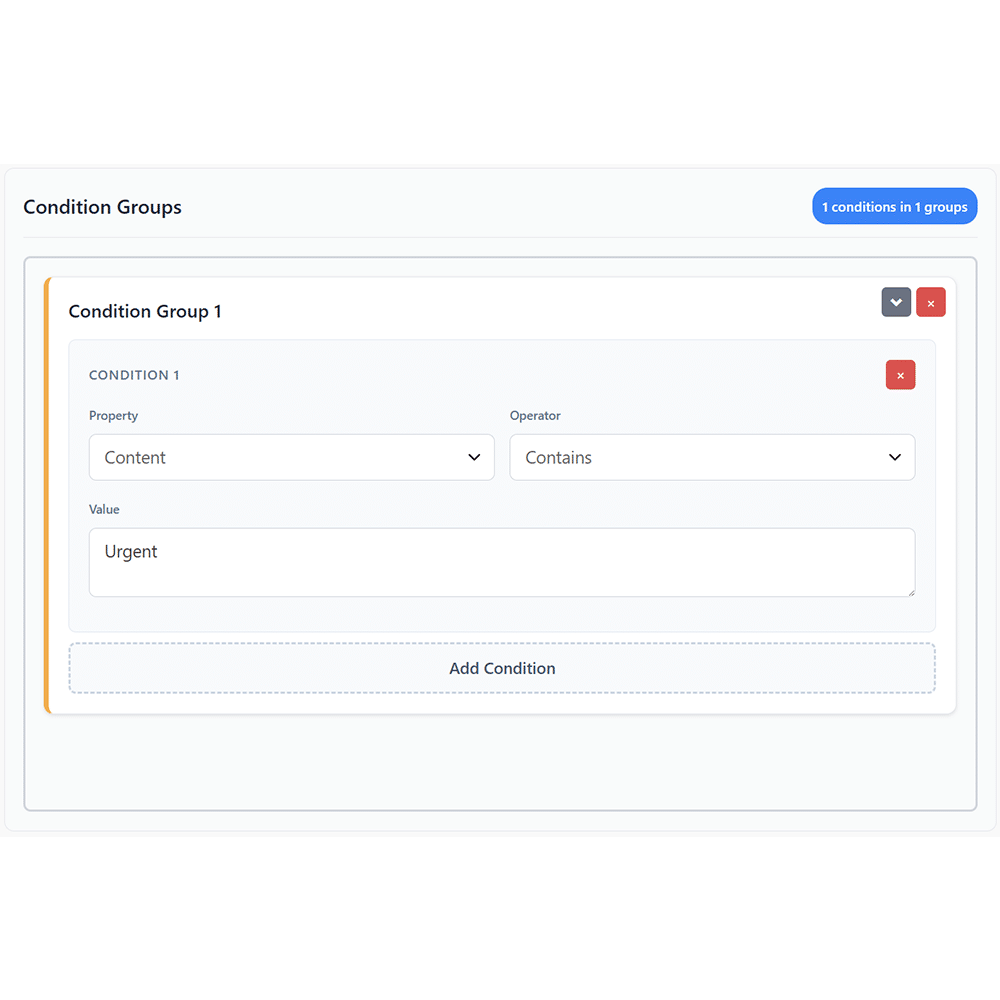
Yes. SMSEagle’s Whatsapp feature makes this fully automatic. Once configured, every incoming WhatsApp message — or only those matching your defined conditions — gets forwarded as an SMS to one or more phone numbers. No manual intervention, no switching between apps. You can also use variables like {{sender}} and {{content}} in the SMS template, so the forwarded message includes the original sender details and message text.
This requires a gateway that bridges the two channels. With SMSEagle, you can configure a workflow where incoming SMS messages trigger a WhatsApp notification — so your team can monitor and respond to SMS communication directly within WhatsApp if that’s their preferred tool. The Whatsapp integration takes a few minutes of the SMSEagle interface.
To convert a WhatsApp message to text, you can use SMSEagle’s WhatsApp to SMS forwarding feature, which automatically extracts the message content and sends it as a plain SMS text message. This allows you to receive WhatsApp messages as standard text messages on any phone.
Using WhatsApp to text (SMS) forwarding is useful when recipients do not have WhatsApp installed or lack internet access. It ensures important messages reach everyone regardless of their app preferences or connectivity. It also provides instant alerts via SMS when mobile data is off, increases communication reliability, and helps businesses, parents, and teams stay connected without missing critical information.